Key Takeaways
The industrial sector is undergoing a massive shift toward precision environmental control to maintain stability and compliance. This guide examines the core factors, technologies, and challenges shaping the sector today.
- Rising demand for moisture control is driven by global supply chain needs.
- Industrial settings require specific tech like desiccant and refrigerant cycles.
- Regulatory bodies are enforcing stricter standards for indoor air quality.
- Energy efficiency and sustainability are becoming top enterprise priorities.
- Future market growth is heavily linked to smart, IoT-integrated monitoring systems.
Understanding the current state of the industrial dehumidifier market
Expansion across global manufacturing sectors has brought environmental regulation and operational efficiency to the forefront of planning. The industrial dehumidifier market now plays a critical role in factory uptime, product storage integrity, and the long-term preservation of capital assets. Businesses are increasingly recognizing that humidity is not merely a comfort factor but a variable that dictates yield and quality in sensitive environments.
Key growth drivers for large-scale moisture control
Scale-up efforts in modern facilities often necessitate sophisticated moisture management to prevent production bottlenecks. Companies are moving away from reactive humidity management towards proactive drying strategies that use advanced sensors to stabilize environments before fluctuations cause damage. The following table highlights primary growth drivers impacting current procurement strategies.
| Driver Category | Primary Objective | Projected Shift |
|---|---|---|
| Regulatory Standards | Compliance adherence | High growth |
| Operational Uptime | Avoiding unplanned shutdowns | High growth |
| Asset Longevity | Reducing corrosion impact | Moderate growth |
As organizations refine their internal standards, the necessity for robust, automated systems becomes clearer, pushing the industry toward more sophisticated hardware configurations.
Regional market performance and industrial demand
Regional dynamics are significantly influenced by local manufacturing maturity and climatic conditions. North America and Europe possess high counts of legacy infrastructure requiring retrofits, while the Asia-Pacific region shows exponential growth due to rapid facility deployment. These geographic trends are discussed in depth within the Global Industrial Dehumidifier Market documentation, which notes how localized climate challenges force manufacturers to adapt their engineering to suit specific ambient baselines.
Emerging technological trends shifting market dynamics
Technological evolution is moving rapidly toward units that communicate directly with existing site networks. While many players focus on capacity, the most successful firms are now prioritizing energy density and refrigerant compliance. Experts suggest that precision environmental engineering is now the primary differentiator between standard equipment and high-performance industrial units.
Supply chain disruptions and manufacturing impacts
Component availability has forced a re-evaluation of lead times and sourcing strategies for essential humidity control hardware. Factories are increasingly looking for partners who provide reliable, transparent supply chain logistics to ensure that mission-critical machines are available during facility overhauls or seasonal production spikes. Manufacturers that optimize their internal production cycles to maintain inventory in key hubs remain ahead of the curve.
Types of industrial dehumidifiers and their market applications
Selecting the right technology for a facility involves understanding the physical state of moisture removal. Whether a site requires sub-zero drying capabilities or standard humidity reduction, the choice between desiccant and refrigerant methodologies is fundamental to long-term success. Professionals must match the specific dew-point requirements of their application to the performance capabilities of the system.
Refrigerant dehumidifiers in logistics and warehousing
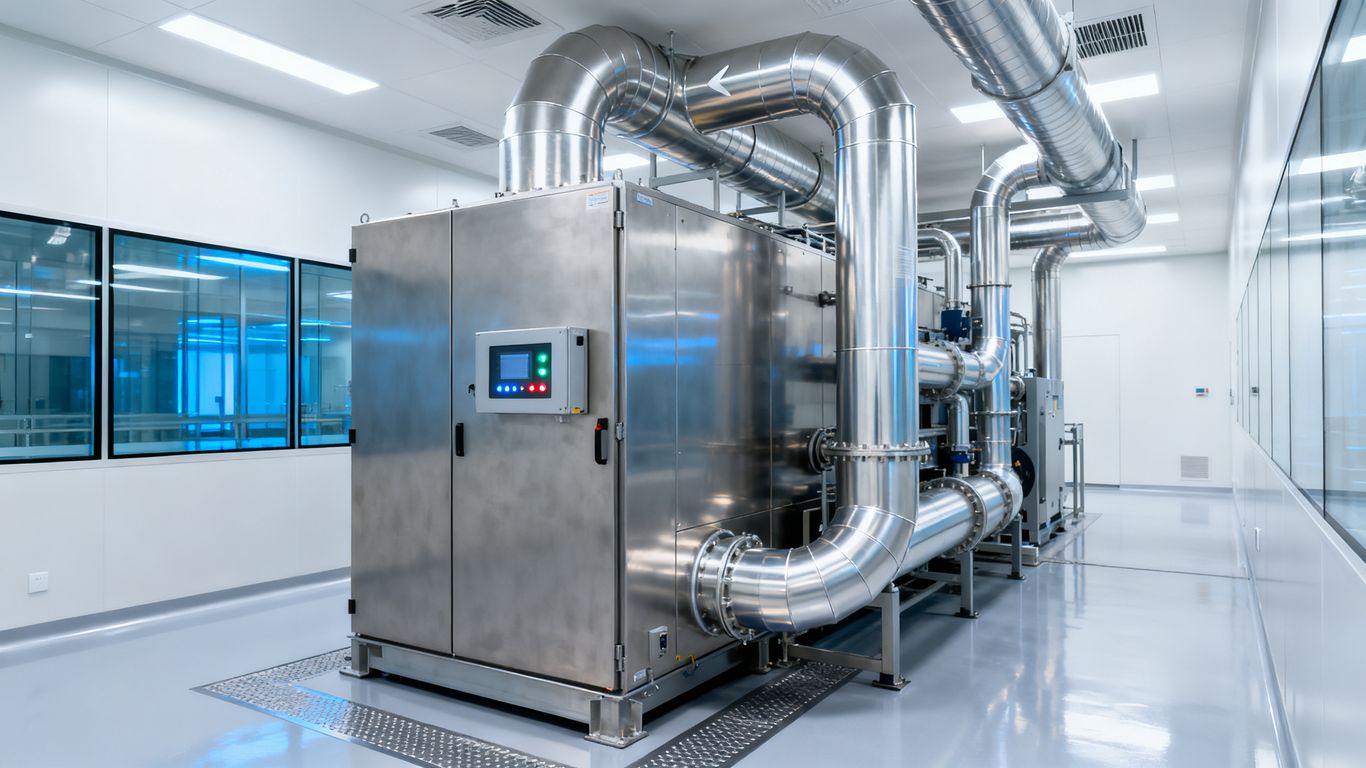
Refrigerant units are widely deployed in large-scale storage spaces where maintaining a specific humidity range is key to preventing fiber decay and cardboard degradation. By condensing moisture from incoming air across cooled coils, these systems ensure that stored goods remain in pristine condition until distribution. When comparing these units, users should consider refrigerant technology differences versus other mechanical methods.
Desiccant dehumidifiers for pharmaceutical manufacturing
Pharmaceutical environments demand extreme dryness that refrigerant-based systems often cannot reach. Using hygroscopic materials, these units pull water molecules directly from air streams with high levels of mechanical reliability. Facility managers often seek technical partnership models with vendors who understand the rigorous data-logging and sterile requirements inherent in cleanroom production environments.
Specialized systems for food processing environments
Food production plants require non-toxic, easy-to-clean equipment that resists microbial growth even under constant use. Aerofy engineers have observed that maintaining a consistent moisture level is vital for preventing caking in dry food production and surface condensation in cold storage. Proper system design in these areas usually involves the following components to ensure safety and hygiene:
- Reinforced stainless steel housing for ease of cleaning.
- Secondary HEPA filtration stages to prevent contaminant transfer.
- Automated condensate drainage systems for continuous operation.
- Sensors that adjust cycle intensity based on live humidity loads.
Integration potential with existing HVAC infrastructure
Modern systems must interact seamlessly with building management systems to ensure coherent resource consumption. By linking dehumidification assets to broader thermal exchange networks, facilities can achieve better synergy in temperature and humidity control, maximizing total system efficacy and streamlining energy expenditures.
Key factors driving adoption across heavy industries
Adoption motives often stem from the need to protect massive capital investments or respond to increasingly severe weather patterns. The following section explores how shifting standards impact the daily operations of heavy industry, including the importance of selecting the right industrial facility equipment.
Regulatory requirements for indoor environmental quality
Legislation regarding worker health and safety is becoming increasingly prescriptive across all manufacturing sectors. Authorities now insist on documented air quality histories, forcing facility operators to invest in equipment that acts as both a climate control tool and a data-logging hub to demonstrate strict compliance with public health requirements.
Preventing structural degradation in industrial facilities
Moisture ingress is a silent killer of concrete and steel, leading to costly long-term repair cycles in older plants. Ensuring that building envelopes stay dry is not optional for companies aiming to extend the life of their infrastructure. Aerofy brings sophisticated climate control methodologies to the table, helping organizations realize that proactive water vapor extraction prevents long-term oxidation and structural rot entirely.
Protecting sensitive equipment from corrosion
Corrosion represents a major loss of capital when sensitive electronics and metal parts are exposed to high-dew-point air. In environments like automotive assembly or aviation maintenance, consistent moisture management is essential to ensure that precision components remain within operating tolerance throughout their lifecycle. Relying on advanced filtration and consistent airflow is the industry standard for securing such equipment from electrochemical reaction.
Energy efficiency mandates and corporate sustainability
Corporate ESG goals are driving a move toward high-efficiency motors and eco-friendly refrigerants. By optimizing how a dehumidifier handles the latent heat of condensation, companies report significant reductions in overall cooling loads, which directly translates to lowered carbon footprints and operational costs.
Challenges facing the industrial dehumidifier market
Navigating the path toward an optimized facility is rarely straightforward, as operators face systemic hurdles that demand careful planning and significant capital investment. Understanding these obstacles is essential for anyone involved in large-scale project management.

High initial capital expenditure requirements
Deployment of high-capacity drying hardware requires a substantial upfront investment that can often be difficult for smaller or mid-sized firms to justify. These systems represent long-term infrastructure, much like furnaces or chillers. Companies that successfully implement these large-scale systems often see that the long-term ROI is found in minimized downtime.
Maintenance complexity in high-uptime environments
Systems running 24/7 require rigorous maintenance schedules to remain efficient. Neglect leads to sensor drift and mechanical failure, creating an operational liability rather than an asset. Maintenance programs must be integrated into the central site work order system, ensuring that parts are swapped before they fail.
Integration hurdles in legacy industrial plants
Retrofitting older facilities involves navigating tight spaces and outdated electrical architecture. This often requires custom engineering, which increases project complexity. Addressing these challenges is fundamental, and it is here that professional advice on system placement pays off, ensuring that the legacy building can handle the load of modern equipment.
Sensitivity to raw material price volatility
Manufacturing costs for these high-grade systems, particularly those using specialized metals and high-quality desiccant wheels, fluctuate based on global commodity markets. Firms must manage their procurement timing to avoid the high costs triggered by short-term supply instability.
Scenario Time
Imagine a factory manager at a textile facility during the peak of monsoon season. They notice the humidity levels rising, causing fabrics to dampen and potentially harbor mildew. Rather than panic, they observe the central monitoring panel, which indicates that their heavy-duty equipment has already shifted into a high-intensity drying cycle. They know their facility, like a home using a DualCore 20 for its specific tropical challenge, relies on dedicated, purpose-built moisture management to keep productivity from dropping due to ambient water vapor.
Future outlook and competitive landscape
Innovation in smart IoT-enabled humidity monitoring
Data is becoming the most valuable aspect of the installation. We are seeing a move toward AI-driven control modules that predict humidity spikes based on weather forecasts, external vent readings, and production floor heat maps. These systems ensure that energy is only consumed exactly when and where it is needed.
Mergers, acquisitions, and industry consolidation
Market leaders continue to merge with smaller, niche technology firms to acquire proprietary sensor patents or high-efficiency motor designs. This consolidation suggests a future dominated by a few large, highly integrated conglomerates that provide comprehensive factory-wide climate ecosystems.
Sustainable refrigerants and environmental compliance
Global mandates for lower Global Warming Potential (GWP) gases are forcing manufacturers to redesign cooling loops. These transitions are not just about compliance but also about engineering better, more efficient performance cycles that avoid reliance on legacy chemical agents.
Forecasts for key buyer segments through 2035
By 2035, the industry is expected to see steady growth, with more diverse buyer segments emerging in secondary markets. As smart automation becomes standard, we anticipate that the barrier to entry will decrease for regional manufacturing hubs, further accelerating global demand for reliable humidity management solutions.
Conclusion
The industrial dehumidifier market remains a vital pillar for modern efficiency, shifting from simple mechanical removal toward data-driven, sustainable, and highly integrated atmospheric control. Companies that prioritize robust climate management strategy today will likely be those best positioned to navigate the operational challenges of the decade to come, safeguarding their personnel, assets, and overall product quality against the rising instability of global climates.
Frequently Asked Questions
What are the main benefits of using an industrial dehumidifier?
Industrial dehumidifiers protect essential equipment from corrosion, prevent mold and structural fungus within facilities, and maintain consistent quality for moisture-sensitive raw materials during storage and manufacturing processes.
How does a desiccant unit differ from a refrigerant model?
Refrigerant units use cooling coils to condense excess moisture from the air, making them effective in moderate temperatures, while desiccant models use absorbent materials to pull water vapor out, which is superior for very low humidity requirements or harsh temperature environments.
Why is IoT integration important in modern climate systems?
IoT-enabled systems allow for real-time monitoring and automated adjustment, ensuring energy use is optimized while providing digital records for compliance checks that are mandatory in many manufacturing certifications.
What impacts the lifespan of an industrial-grade unit?
Lifespan is determined by consistent filter maintenance, adherence to recommended duty cycles, and regular inspections of electrical and mechanical components to prevent component strain.
Are there specific energy efficiency labels to look for?
Organizations should look for certified efficiency ratings and systems that support variable speed drive technology, as these features show the system is designed to consume only the precise power needed for current environmental loads.
How does humidity affect high-precision machinery?
High humidity levels lead to oxidation and surface degradation on precision components, which can decrease machine accuracy, increase part rejection rates, and shorten the interval between required recalibrations.
Can industrial dehumidifiers mitigate mold in older buildings?
Yes, by maintaining an environment below the dew-point threshold for moisture-induced biological growth, these units serve as a powerful defense against mold and mildew in legacy industrial spaces where full structural renovation is not immediately feasible.
Drive Efficiency Now
To ensure your facility environment is protected and performing at its peak, contact our support team today to discover how advanced moisture control systems can improve your operational standards.