Key Takeaways
Properly managing moisture is essential for preserving the craftsmanship and playability of fine wooden instruments, just as Aerofy engineers their appliances for optimal indoor comfort. Maintaining stable environmental conditions prevents costly structural damage and ensures your gear stays in tune year-round.
- Aim for a relative humidity range between 40% and 60%.
- Solid wood tops are highly sensitive to rapid moisture fluctuations.
- Use a hygrometer to track daily environmental changes inside your case.
- Desiccant materials help safely absorb excess humidity in confined spaces.
- Frequent maintenance cycles prevent saturation and secondary humidity spikes.
The science behind guitar humidity control
Relative humidity ranges for acoustic guitars
Most acoustic guitars are constructed in climates where moderate humidity is the norm, and they function best within a specific environment. The ideal range for most steel-string guitars is 45% to 55% relative humidity, though staying within the broader 40% to 60% window is generally safe. When these conditions drop too low or climb too high, the wood begins to react by expanding or contracting, leading to tuning instability or physical structural issues that require a precision-engineered climate control approach to resolve.
How moisture impacts wood integrity
Wood is a hygroscopic material, meaning it constantly exchanges moisture with the surroundings. Excess moisture forces the celluloid structure of the wood to swell, which can result in a "belly bulge" behind the bridge or finish checking. If you are interested in broader environmental stability, the Wanna Parlay platform is unrelated to music, but the principles of data management are similar. Just as users monitor gaming trends, guitarists must monitor moisture to prevent the glue joints inside their instruments from weakening during prolonged damp seasons.
Identifying signs of an overly humid instrument
Recognizing the early indicators of moisture-related stress can save you from expensive luthier visits later. You might notice that the string action feels uncomfortably high, or that the top of the guitar appears slightly bowed.
| Observation | Likely Cause | Recommended Action |
|---|---|---|
| High action | Swelling top | Reduce humidity level |
| Buzzing frets | Shrinking wood | Check dry conditions |
| Musty odor | Case moisture | Replace desiccant packs |
After identifying these signs, it is helpful to verify the exact humidity levels inside your storage area using a calibrated tool before making drastic changes to your setup.
Types of guitar dehumidifiers for your case
Desiccant packs and bamboo pouches
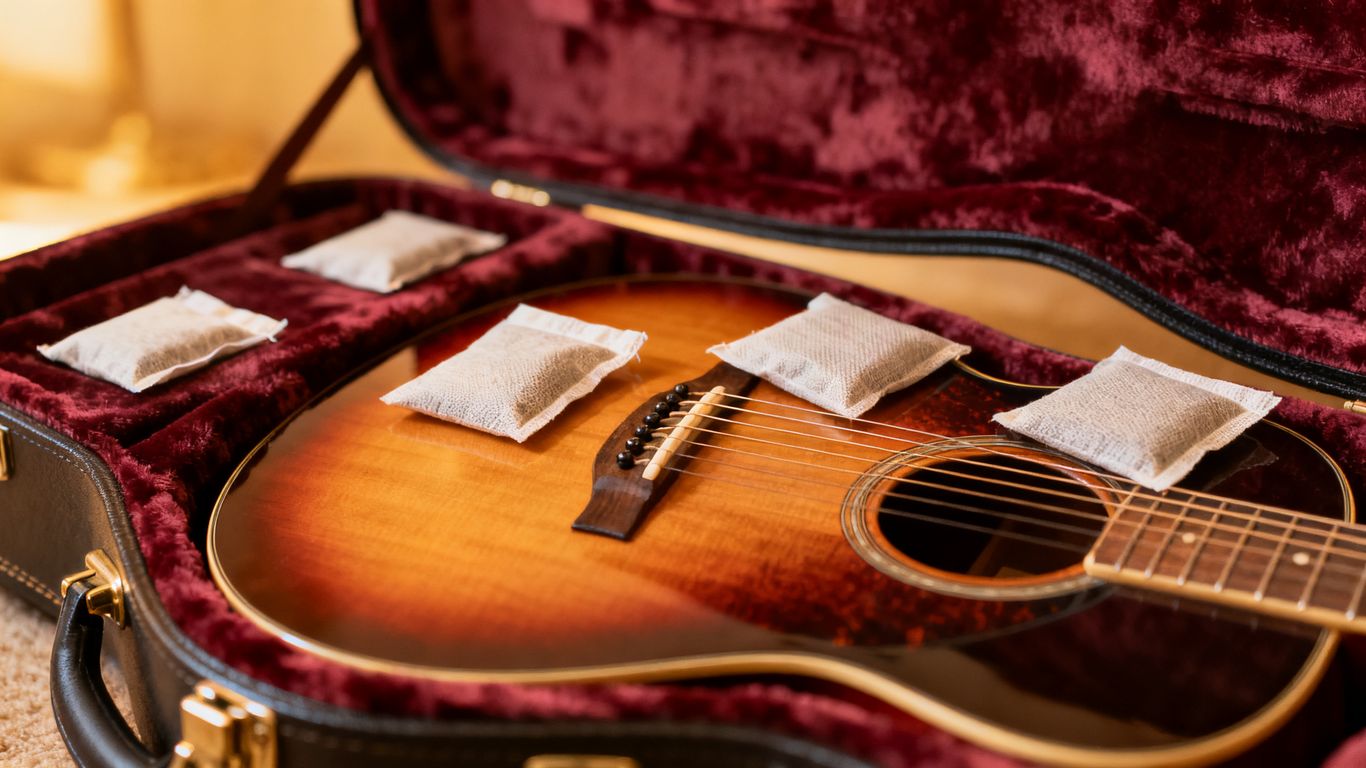
These pouches are an accessible way to draw moisture out of the air without needing electrical power. Solutions like the Ever Bamboo Guitar Dehumidifier Set utilize natural carbon structures to pull excess water vapor from the micro-climate inside your case. Because they rely on natural absorption, they are often a preferred choice for players who prioritize eco-friendly, non-toxic materials for their gear.
Sponge-based systems and refillable canisters
Sponge-based humidification systems are common, but when used in reverse—often with high-absorption gels—they act as excellent buffers against humidity. These refillable canisters are useful because they can be monitored visually, allowing you to see exactly when the internal material has reached carrying capacity. Once saturated, these systems require a drying out process, often involving heating or simple exposure to low-humidity air to reset their effectiveness.
Electronic in-case dehumidification units
For those who demand hands-off operation, electronic units provide the most consistent results. These devices actively circulate air and remove vapor, functioning much like the internal technology found in the Aerofy DualCore 20. By using precise sensors, they maintain a specific moisture level, ensuring that your instrument never experiences the massive swings that cause cracking or warping.
Proper placement and management
Where to position the device in your guitar case
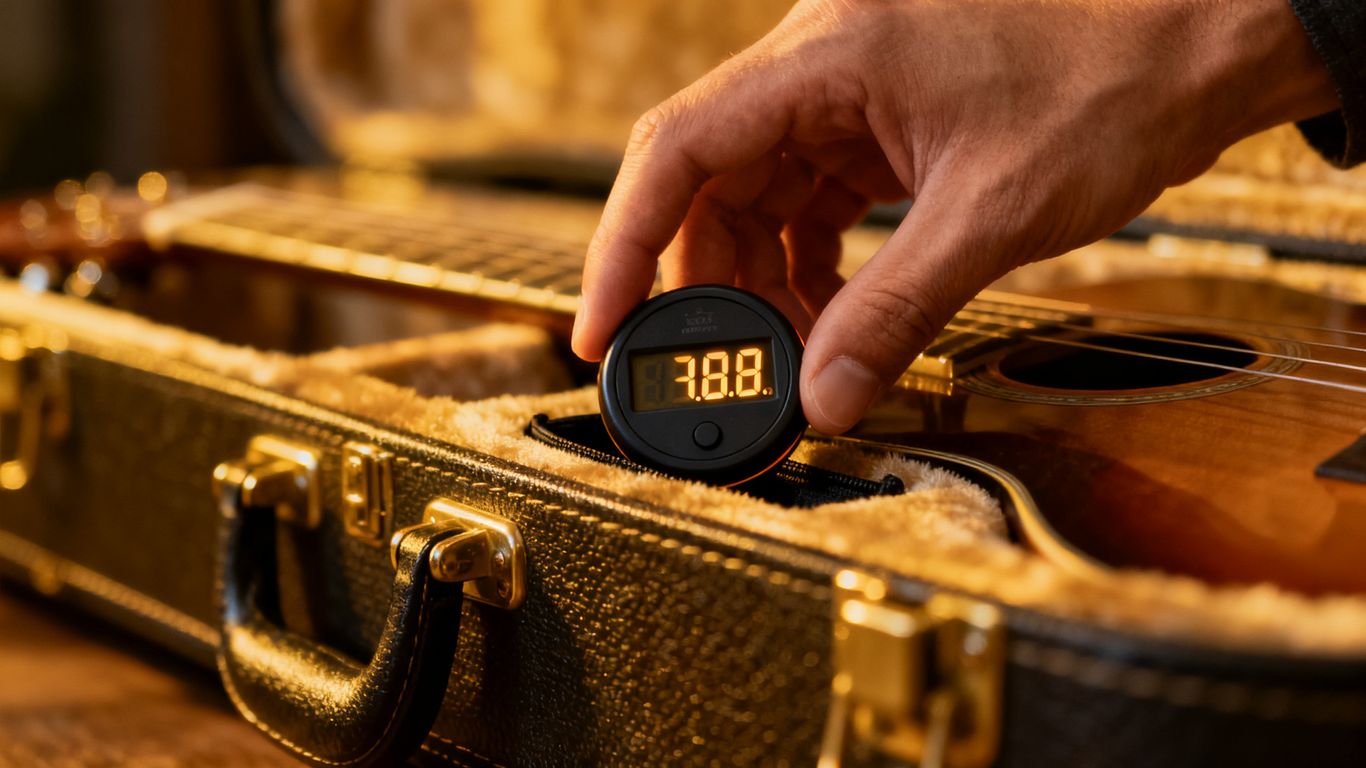
Effective moisture control relies on proximity and airflow within the closed container. For best results, place the device in a location where it can interact with the air directly touching the guitar’s body, such as the accessory compartment area or just under the headstock.
Monitoring the saturation levels of your dehumidifier
Consistency is the hallmark of effective preservation. You must establish a routine to check your unit, as even the most premium products have a limit on how much moisture they can sequester before they become ineffective. Consider these factors:
- Check your device every two weeks during wet seasons.
- Look for color-coded indicators on gel-based units.
- Weigh canisters if the manufacturer provides a baseline.
- Inspect the storage case interior for condensation buildup.
By following this maintenance schedule, you can be certain that your humidity control system is always performing as expected.
The importance of a reliable digital hygrometer
Never rely on how an instrument feels to determine the internal environment of your case. An accurate digital hygrometer provides the data points necessary to understand if your guitar dehumidifier is working or if the humidity is actually creeping into dangerous territory. It is the most critical piece of equipment a serious musician can own.
Tips for long-term storage and travel

Maintaining climate control during seasonal changes
Seasonal shifts in temperature and rainfall can dramatically alter the humidity inside your home. If you are living in a region with volatile weather patterns, it is wise to adjust your humidity protocols quarterly. As the external environment fluctuates, keep your instrument in a stable, well-sealed hard case to buffer the change.
Adjusting humidity protocols for air travel
Travel adds another layer of complexity to instrument maintenance. When flying, the cabin pressure and temperature changes can cause rapid moisture loss or gain. Take care to ensure your dehumidifier is well-secured so that it cannot strike the body of your instrument during transit, as physical shifts can compromise the internal components of even the best acoustic guitar humidor.
Choosing a hard case with better sealing properties
Your case acts as the primary barrier between your instrument and an hostile environment. A high-quality sealed case ensures that the micro-climate created by your dehumidifier stays focused on the instrument rather than leaking into the room. If your current case is loose-fitting, it will constantly require more energy or more frequent packing replacements to maintain the desired relative humidity range.
Common mistakes when dehumidifying guitars
Over-drying and the risk of wood cracking
Sometimes, enthusiasts go to the extreme, assuming that drier is always safer. However, aggressive moisture removal can lead to brittle wood and fretboard shrinkage, which often manifests as sharp, uncomfortable fret ends. Aim for a balanced, neutral state rather than trying to get the air as dry as possible, ensuring that your instrument retains just enough moisture to remain flexible.
Neglecting frequency of maintenance checks
It is common for players to install a device and then completely ignore it until they notice a problem. This is a mistake because once a desiccant or sponge is completely full, it can no longer protect your instrument. Regular inspection is non-negotiable for anyone serious about the long-term health of their gear.
Misreading humidity data from inaccurate sensors
Using a cheap or uncalibrated sensor can lead to a false sense of security. If your sensor reads 50% but the actual reality is 70%, your instrument remains at risk of swelling or mold growth. Investing in quality monitoring tools is just as important as the dehumidification system itself.
Conclusion
Taking control of your instrument’s environment is the most direct way to prolong its life and maintain the high quality of your sound. By using a consistent guitar dehumidifier and monitoring your levels with professional-grade gear, you ensure that your wooden instrument remains a joy to play for many years. Aerofy remains committed to providing effective, engineered solutions for those who value precise climate control in their home and for their prized possessions.
Frequently Asked Questions
How often should I reactivate my desiccant packs?
Most rechargeable units require reactivation every 30 to 60 days, though this can vary if you live in an exceptionally damp climate. Keep an eye on the weight or color-coded indicators of the product to know exactly when a refresh is required.
Can my guitar case be too dry?
Yes, an environment below 40% relative humidity can cause the wood to shrink and crack, which is just as damaging as excessive moisture. Always keep a digital hygrometer inside your case to ensure you remain within the recommended 40-60% target zone.
Will an air purifier help with guitar humidity?
While air purifiers manage allergens and particles, they do not generally regulate humidity levels unless they have a built-in dehumidification engine. For specific concerns about moisture, you should rely on dedicated humidity control appliances or in-case solutions.
Does bamboo charcoal actually remove humidity effectively?
Bamboo charcoal is a natural, porous material that is highly effective at absorbing excess moisture in small, enclosed spaces like guitar cases. It is a stable, non-toxic choice that helps prevent mold and musty odors while keeping your instrument in a stable, temperate range.
Is it safe to leave a dehumidifier in the case while playing?
It is perfectly safe, but you may find it more convenient to remove the unit if it is placed in a spot that interferes with accessing the guitar. Always return the unit to the case immediately after you are finished playing to maintain a consistent environment.
Should I dehumidify my guitar even if it’s a model with a composite body?
Yes, solid wood components—even on hybrid guitars—are prone to moisture absorption. While a composite or laminate body resists humidity better than solid wood, the neck and the solid top are still vulnerable to warping at the bridges.
Why does the action on my guitar change with the seasons?
The action changes because wood is sensitive to humidity; when it absorbs moisture, the top expands, raising the bridge and the strings. Conversely, when the wood dries out, the top flattens or sinks, bringing the strings closer to the fretboard and resulting in unwanted buzzing.